
Description
Between 1915 and 1923, Marcel Duchamp created one of the most mystifying art works of the early twentieth century:
(also known as the
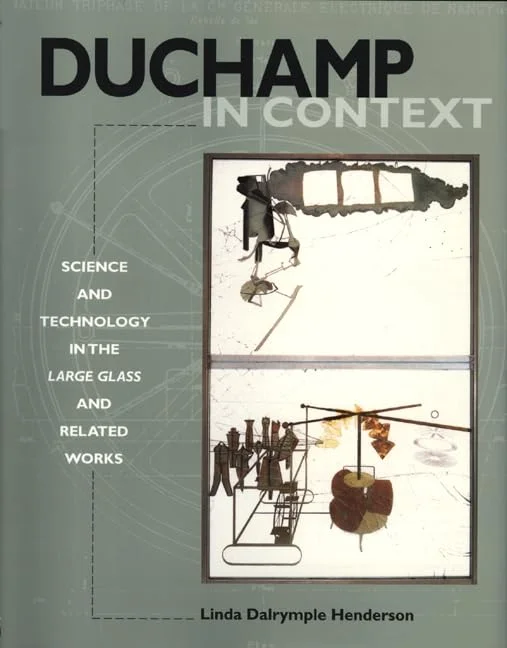
). The work is over nine feet tall, and on its glass surface Duchamp used such unorthodox materials as lead wire, lead foil, mirror silver, and dust, in addition to more conventional oil paint and varnish. Duchamp’s declared subject is the relation between the sexes, but his protagonists are biomechanical creatures: a “Bride” in the upper panel hovers over a “Bachelor Apparatus” in the panel below, stimulating the “Bachelors” with “love gasoline” for an “electrical stripping.”
In preparation for the
, Duchamp wrote hundreds of notes, which he considered just as important as the work itself. He published 178 during his lifetime, but over 100 more notes relating to the
were discovered and published following his death. In this landmark book, Linda Henderson provides the first systematic study of the
in relation to the entire corpus of Duchamp’s notes for the project. Since Duchamp declared his interest in creating a “Playful Physics,” she focuses on the scientific and technological themes that pervade the notes and the imagery of the
. In doing so, Henderson provides an unprecedented history of science as popularly known at the turn of the century, centered on late Victorian physics. In addition to electromagnetic waves, including X-rays and the Hertzian waves of wireless telegraphy, the areas of science to which Duchamp responded so creatively ranged from chemistry and classical mechanics to thermodynamics, Brownian movement, radioactivity, and atomic theory. Restored to its context and amplified by the information in the posthumously published notes, the
appears far richer and more multifaceted and witty than had ever been suspected.
Henderson also includes a close examination of Duchamp’s literary and artistic models for creative invention based on science, including Alfred Jarry, Raymond Roussel, Frantisek Kupka, and Guillaume Apollinaire. The book will not only redefine scholarship on Duchamp and the
, but will be a crucial resource for historians of literature, science, and modernism.


Reviews
There are no reviews yet.